So, I started back at TAFE today. We spent the morning session doing critiques of shopping websites -their usability issues, what they do well, what they do poorly and so on- which was very in depth.
We moved on to class diagrams in the afternoon and covered "setters & getters", which we didn't do last year. Setters are procedures that allow you to change a value of an object. Getters are functions that allow you to view the value of an object, without changing the value.
Oh yeah, and I created a table in SQL2005 using Visual Studio 2008.
Wednesday, February 24, 2010


Shopping website critique
This is a brief critique of the City Software website, complete with a product taken through -almost- to the point of purchase. I would have gone all the way, but I would most likely have had divorce papers waiting for me when I got home.


Tuesday, February 23, 2010
First Blog for Diploma 2010...
This is my first blog for 2010. I have just started the Diploma part of my course, and this blog makes up part of my assessable marks.
Please stay tuned for all sorts of insights -and laughs, my God will I supply laughs. If there was a programmers stand up club, I would be a star- and, well, just general bollocks really.
Please stay tuned for all sorts of insights -and laughs, my God will I supply laughs. If there was a programmers stand up club, I would be a star- and, well, just general bollocks really.
Monday, August 17, 2009
Database types and definitions
This weeks blog task has two parts:
The second question is open to a bit of interpretaion. Many of the answers in the class had things like MySQL, Oracle, Access, SqlServer. According to WikiAnswers, the different types of databases are, "Hierarchical, Network, Relational, Object Relational".
- What is a database? In our own words, describe what we think a database is.
- What are the different types of databases? Give examples of the different types of databases.
A database is an integrated collection of logically related records or files which consolidates records into a common pool of data records that provides data for many applications.If I was putting this in to my own words, I would describe it as a collection of information that is structured in such a way that any relevant information is easily accessible.
The second question is open to a bit of interpretaion. Many of the answers in the class had things like MySQL, Oracle, Access, SqlServer. According to WikiAnswers, the different types of databases are, "Hierarchical, Network, Relational, Object Relational".
Sunday, August 9, 2009
Studying for Chapter 8 test...
One of the questions in the practice test was this one from the True/False section:
I know, I know... Page 592 has a table with six exception types in it. But I direct you to the paragraph above the table:
Anyway, I went searching and found another, larger, yet still by no means exhaustive, list of exceptions. It can be found at http://www.exforsys.com/tutorials/vb.net-2005/vb.net-exceptions.html and succeeds where the book fails, gives us a definitive answer to the question.
And just in case you are wondering... Yes, I am grumpy. Bloody Cats!!! Someone must have swapped their playbook with The Hitchhikers Guide to the Galaxy because it apparently has the words "Don't Panic" written across the front in large, friendly letters. Yeah right, 7 of our best 22 out injured and another 6 of them playing with injuries or just out of form, four weeks from finals... Nah, don't worry about panic, I think we've moved beyond that point. Next stop, despair.
- 8. Only six different types of exceptions can occur in a visual basic program.
I know, I know... Page 592 has a table with six exception types in it. But I direct you to the paragraph above the table:
Different types of exceptions can occur. The table shown in figure 8-46 identifies some of the of the possible exceptions.Does this meant the correct answer is False? The table after all only shows six exceptions and it doesn't say anywhere in the text, "This list is by no means exhaustive or complete" etc. So you could probably make a case for saying that the answer is True if you really wanted to push it.
Anyway, I went searching and found another, larger, yet still by no means exhaustive, list of exceptions. It can be found at http://www.exforsys.com/tutorials/vb.net-2005/vb.net-exceptions.html and succeeds where the book fails, gives us a definitive answer to the question.
And just in case you are wondering... Yes, I am grumpy. Bloody Cats!!! Someone must have swapped their playbook with The Hitchhikers Guide to the Galaxy because it apparently has the words "Don't Panic" written across the front in large, friendly letters. Yeah right, 7 of our best 22 out injured and another 6 of them playing with injuries or just out of form, four weeks from finals... Nah, don't worry about panic, I think we've moved beyond that point. Next stop, despair.
Tuesday, May 5, 2009
Cats and Dogs Assignment
I discovered a few things while doing my Cats and Dogs assignment. Firstly, you can make one panel the child of another panel without realizing it. I made this mistake as I have four panels that fit in to the space of one panel. When I slid them in to place manually, one of the panels wouldn't show up because it was the child of a different panel which, through the code created had had its visibility set to false. This meant that the program would fail to run properly.
What I had to do to fix this problem was to extend the form and seperate all of the panels. I then set the panels in to position using their Location property and then resized the form back to its original size (i.e, big enough to hold one panel). From this point, the program ran perfectly, showing all the panels at the appropriate times.
Another thing I came across was the use of images. I had them set from an absolute path on my memory stick. The problem was that when I handed the assignment in, Rachael wouldn't have access to the pictures for the slide show. I figured that there had to be a way to set the pictures in to the program itself, but I could not see how to do this. I tried putting the pictures into the Resources folder, but I had dragged and dropped and it didn't work when I tried to use Intellisence. I found a very easy to use example for adding pictures to your resource folder written by Craig Cureton, one of the students in the other Cert IV Programming class and this problem was also solved.
I still have two assignments to get done for Programming, the Class Diagram and the Alarm Clock. I'm hoping to have these done by the end of the week.
What I had to do to fix this problem was to extend the form and seperate all of the panels. I then set the panels in to position using their Location property and then resized the form back to its original size (i.e, big enough to hold one panel). From this point, the program ran perfectly, showing all the panels at the appropriate times.
Another thing I came across was the use of images. I had them set from an absolute path on my memory stick. The problem was that when I handed the assignment in, Rachael wouldn't have access to the pictures for the slide show. I figured that there had to be a way to set the pictures in to the program itself, but I could not see how to do this. I tried putting the pictures into the Resources folder, but I had dragged and dropped and it didn't work when I tried to use Intellisence. I found a very easy to use example for adding pictures to your resource folder written by Craig Cureton, one of the students in the other Cert IV Programming class and this problem was also solved.
I still have two assignments to get done for Programming, the Class Diagram and the Alarm Clock. I'm hoping to have these done by the end of the week.
Friday, May 1, 2009
Methods used in Now function...
Our blog task this week is to list the methods that can be used in the Now function. Our assessment involved using the Now function, but we used it in a very simple way. So Rachael has given us this task to show what other methods can be used.
If you want to display the time in a label for example, you might use something like this:
lblCurrentTime.Text = Now
This will retrieve the current time and date from the computer and display it in the label lblCurrentTime. If you only want to display the time though, you would need to do it like this:
lblCurrentTime.Text = Now.ToString("HH:mm:ss")
This will display the time in Hours, Minutes and Seconds. It will only show the time when the program starts though, it won't keep updating the time to keep it current. If you want it to act like a clock, you need to add a Timer function and put this code in to the function as well.
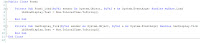
I have been posting a little bit on this function in recent times, relating to my sleep calculator. What I'm going to do is use this function to create a real, bonafide sleep calculator, but that will have to wait until the workload of assignments has thinned out a little bit.
Anyway, what other methods can be added to the Now function? So far ToString has been added. According to the list in Intellisense, the following can be added as methods to the Now function:
If you want to display the time in a label for example, you might use something like this:
lblCurrentTime.Text = Now
This will retrieve the current time and date from the computer and display it in the label lblCurrentTime. If you only want to display the time though, you would need to do it like this:
lblCurrentTime.Text = Now.ToString("HH:mm:ss")
This will display the time in Hours, Minutes and Seconds. It will only show the time when the program starts though, it won't keep updating the time to keep it current. If you want it to act like a clock, you need to add a Timer function and put this code in to the function as well.

I have been posting a little bit on this function in recent times, relating to my sleep calculator. What I'm going to do is use this function to create a real, bonafide sleep calculator, but that will have to wait until the workload of assignments has thinned out a little bit.
Anyway, what other methods can be added to the Now function? So far ToString has been added. According to the list in Intellisense, the following can be added as methods to the Now function:
- Add (AddDays, AddHours, AddMilliseconds, AddMinutes, AddMonths, AddSeconds, AddTicks, AddYears)
- To (ToString, ToLongTimeString, ToOADate, ToShortDateString, ToShortTimeString, ToUniversalTime, ToBinary, ToFileTime, ToFileTimeUtc, ToLocalTime)
- TryParse, TryParseExact
- Compare, CompareTo
- DaysInMonth
- Equals
- From (FromBinary, FromFileTime, FromFileTimeUtc, FromOADate)
- Get (GetDateTimeFormat, GetHashCode, GetType, GetTypeCode)
- IsDaylightSavingTime, IsLeapYear
- Parse, ParseExact
- ReferenceEquals
- SpecifyKind
- Subtract
Subscribe to:
Posts (Atom)


 Posts
Posts